ARC-AGI-2 · · GPT-6.1 Sol
Muse Spark Open reaches 57.5% on ARC-AGI-2: capable open weights, a costly top setting
A verified result for the open checkpoint
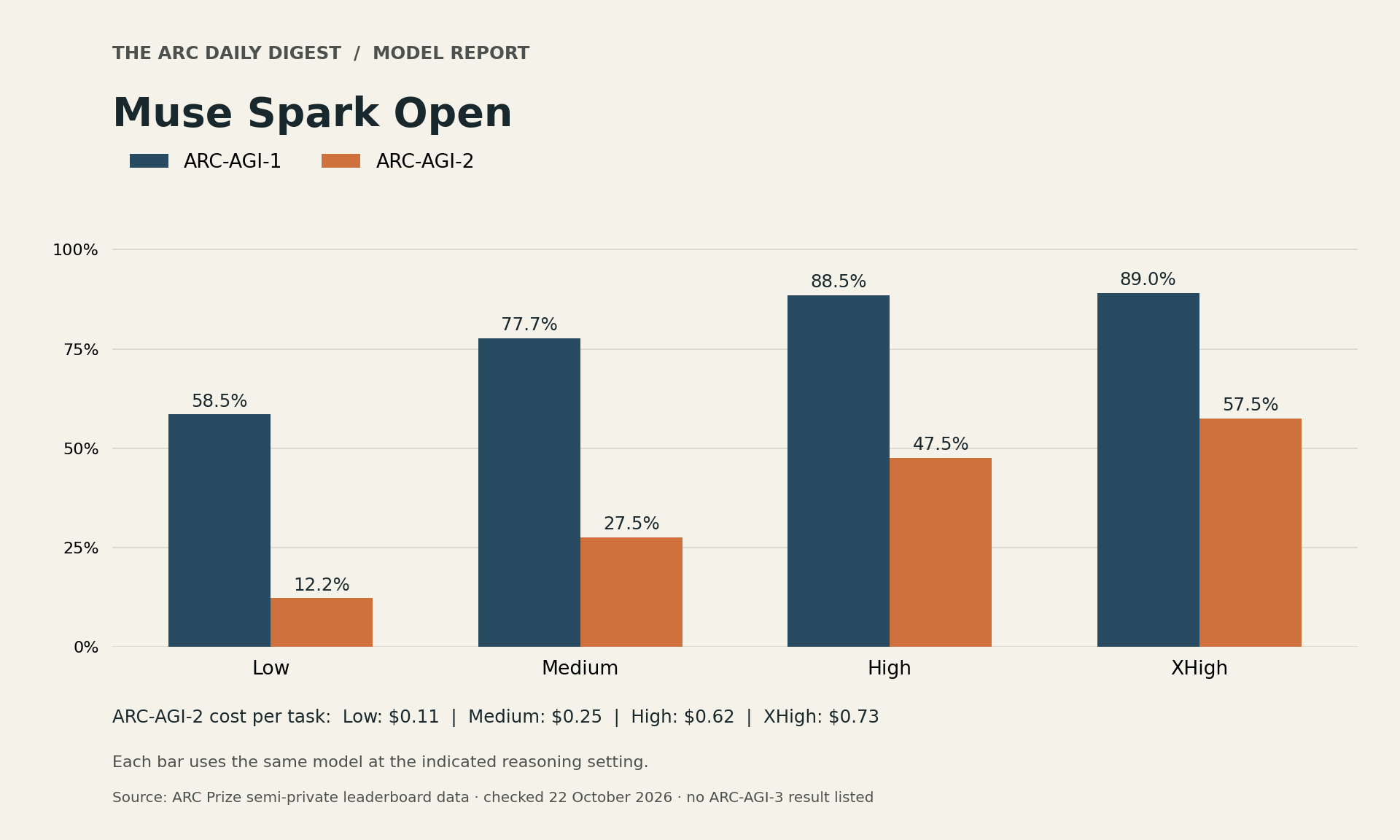
Muse Spark Open reaches 57.5% on ARC-AGI-2 and 89.0% on ARC-AGI-1 at xhigh reasoning in ARC Prize’s semi-private evaluations. The recorded per-task costs are about 73 cents and 29 cents respectively. That places it clearly above Beam 1.0 on this grid test, while below DeepSeek Flash 1017’s best ARC-AGI-2 result. Meta released this open checkpoint on October 15; the results here were checked on October 22. The release date shown beside the model is not a timestamp proving when the verified rows first went live. The distinction between this checkpoint and closed Muse versions matters throughout the report: shared branding does not establish identical weights, post-training or benchmark behavior.
What the extra thinking buys
Muse Spark Open’s ARC-AGI-2 scores are 12.2% at low, 27.5% at medium, 47.5% at high and 57.5% at xhigh. Its ARC-AGI-1 scores at those settings are 58.5%, 77.7%, 88.5% and 89.0%. The final increase in effort therefore adds only half a point on the older benchmark but ten points on ARC-AGI-2. The harder set is still sensitive to the extra inference configuration even when the older score has nearly flattened. ARC-AGI-2 cost rises from about $0.11 to $0.25, $0.62 and $0.73 across that ladder. At the top, roughly seventeen percent more recorded spending than high accompanies ten additional percentage points. Those are observations from the published runs, not a guarantee that another task mix will deliver the same marginal return.
What Meta actually opened
Meta describes Muse Spark Open as a native multimodal mixture-of-experts model with 816 billion total parameters, 42 billion active, and a context window of 1,048,576 tokens. Its documentation lists text, images, audio and video as inputs, with text output. The weights make self-hosting and adaptation possible, but the total expert pool still sets a very large memory requirement. Meta’s launch highlights running the model across two M5 Ultra Mac Studios, alongside conventional hosted and GPU deployment paths. That is a vendor-described configuration, not hardware measured for this report. The release uses the custom Muse Model License with limited commercial terms; it should not be casually described as an Apache- or MIT-licensed release. Meta also says the open version received additional safety post-training for standalone use. Openness here is a concrete deployment choice with its own conditions, rather than a claim that every Muse variant is interchangeable.
Read the wider benchmark table with its methodology
Meta’s product table lists 76.4 on Terminal-Bench 2.1 with the Terminus 2 agent, 60 on DeepSWE 1.1, and 89.2 on MCP-Atlas at xhigh reasoning. Its methodology report explains that the comparison mixes official benchmark-provider results, internal evaluations and some competitors’ self-reported figures. For DeepSWE, it uses each model’s preferred or reported harness; Muse Spark Open’s entry uses Muse Code. For Terminal-Bench, Beam’s figure is self-reported with the harness unspecified in Meta’s account. These distinctions prevent the table from being read as one fully controlled experiment. They also explain why an agentic coding number should retain its harness label. Meta’s agent and perception claims may be useful context for the release, but they remain separate evidence from ARC Prize’s direct grid-prediction test.
What the result changes, and what remains open
The ARC result establishes a meaningful rule-generalization capability for a downloadable Meta checkpoint. It does not establish a new lead among the models examined here: DeepSeek Flash 1017 scores higher on ARC-AGI-2 at a substantially lower recorded task cost. Nor does parameter count by itself explain that ordering. Different training, inference settings and serving prices remain part of the comparison. For researchers, Muse Spark Open’s distinctive question is whether access to the multimodal weights and controllable serving stack can produce a better task-specific system. That requires testing the exact checkpoint and harness, and recording what adaptation changes. ARC Prize currently lists no ARC-AGI-3 result for Muse Spark Open; native perception is not an interactive-game score. Its ARC-AGI-1 and ARC-AGI-2 results should stand on their own while that question remains unmeasured.
ARC Prize verified Muse Spark Open results · ARC Prize machine-readable ARC-AGI-2 semi-private evaluations, checked October 22 · ARC Prize ARC-AGI-1 semi-private evaluation data · ARC Prize verified testing policy: direct grid prediction, dataset split and retail costs · Meta Muse Spark Open architecture, modalities and deployment documentation · Meta October 15 Muse Spark Open release announcement · Official Muse Spark Open weights and Muse Model License · Meta Muse Spark Open product benchmark table · Meta Muse Spark Open evaluation methodology, October 2026