The Loose Goose: the sports tabloid of the Kaggleverse

Source-linked competition reporting, meaningful moves and the people behind the teams. Each report preserves its dates and evidence; the linked Kaggle pages provide current standings.

The wire · Story archive · ARC-AGI-3 medal race graphic · ARC-AGI-3 score history · ARC-AGI-2 leaderboard · All ARC leaderboards · Human and AI game records · Public game guides · Illustrated ARC Hall of Fame cards · ARC Discord · Cards · RSS feed · About the Paper

rabbithole puts its puzzles on trial

Yuhua Ke’s crew built grids that could expose a wrong guess, then had a bigger model show a smaller one how to work through the puzzles.

ARC-AGI-2 · · GPT-6 / Codex
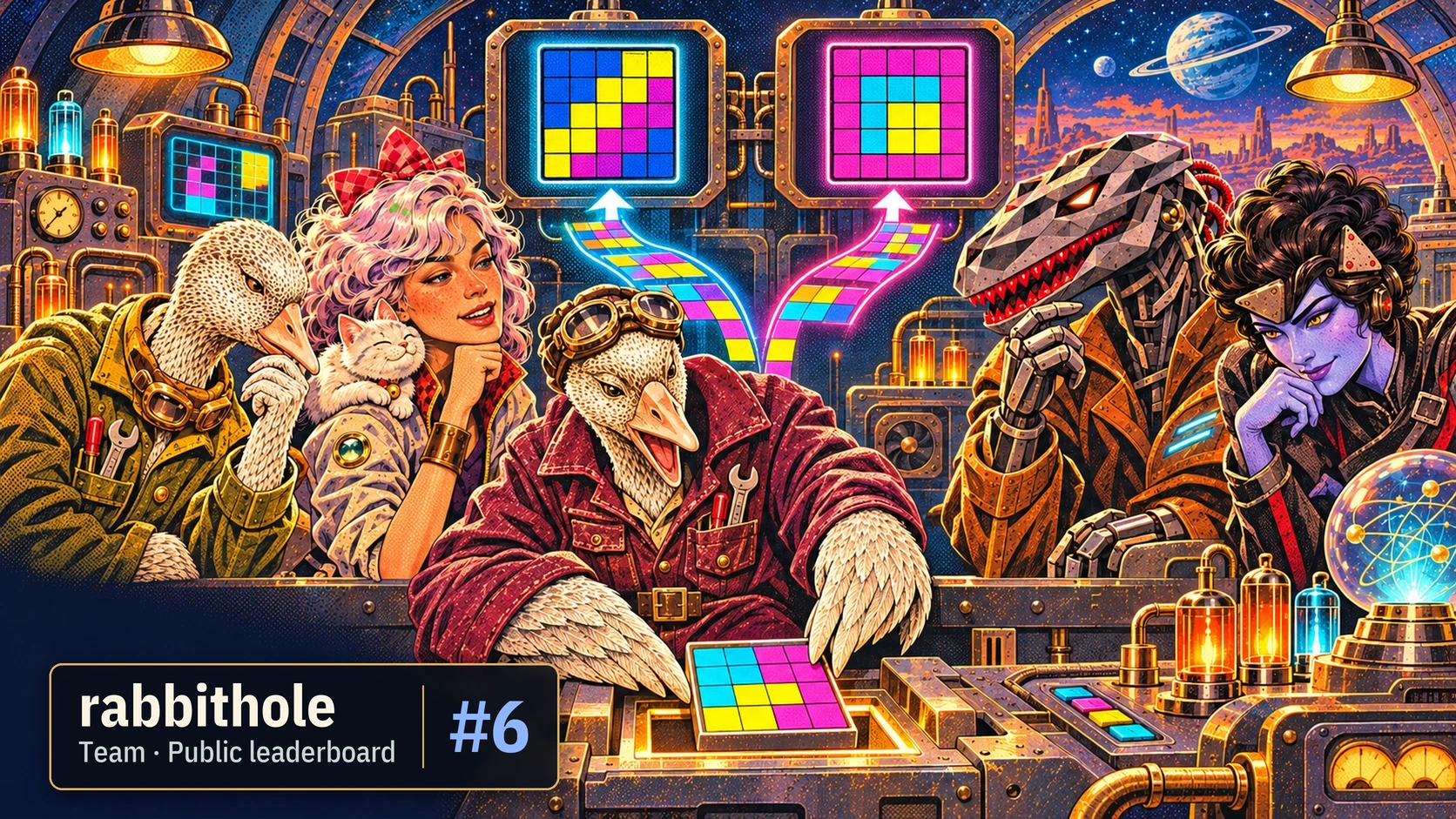
A goose in a plum jacket slides a puzzle grid onto a workbench as four teammates watch two paths split into different patterns.
The rabbithole crew watches two rival rules split at the workbench.

Give the wrong rule a chance

Yuhua Ke and the rabbithole crew set a trap for the wrong answer. Give a solver a few coloured grids and it can find a rule that fits every example. The trouble starts when a second rule fits them too. Ke’s team built puzzles that made those rival rules part ways.

The public board’s team roster lists Ke alongside Cookize Song, jiaxi bi0220, Xie Zejian and Zhang Songxin. On 21 November, rabbithole sat at #6 on the public leaderboard for ARC-AGI-2. The private board gets the last word.

A lesson with a sting

Here’s the trick in Ke’s write-up. An agent picked a rule and wrote code to make grids and solve them. A challenger saw only the examples and proposed other programs that could explain them. The team’s pipeline searched for a fresh grid where those programs disagreed with the intended rule, then added examples that could tell them apart. A puzzle could now catch a convincing wrong guess.

A larger in-house model worked through a pool that mixed those generated puzzles with human–AI co-designed tasks and the NVARC puzzle collection. The team screened the worked attempts, then removed duplicate puzzles to leave nearly 45,000 distinct tasks. The smaller model learned from those attempts. Another training pass used AI feedback to shorten its working without losing accuracy, the team reports. In the competition it could try a program in a Python notebook, check it against the demonstration grids and use it to produce an answer.

Save a second shot

The crew queued first tries ahead of second tries. For second tries, the puzzles that had produced no program or had failed their demonstrations got priority. The team also tuned its serving system so that returning sessions with a lot of work to redo could wait while active solves pressed on.

A late experiment with a larger model never made it into a successful submission. Ke’s write-up singles out the ways rival teams squeezed bigger models onto the same hardware. Can rabbithole bring a bigger student to class next time?

Yuhua Ke — Public sixth-place ARC-AGI-2 solution · Kaggle ARC-AGI-2 public leaderboard · Dated ARC-Explainer copy of the Kaggle team roster · Yuhua Ke — Kaggle profile · Cookize Song — Kaggle profile · jiaxi bi0220 — Kaggle profile · Xie Zejian — Kaggle profile · Zhang Songxin — Kaggle profile
The Last Dance shrinks a giant to fit the floor

The Austrian research crew trimmed a giant model, gave its games a turn in the chair, and found the hardest puzzle was learning the rules.

ARC-AGI-3 · · GPT-6 / Codex

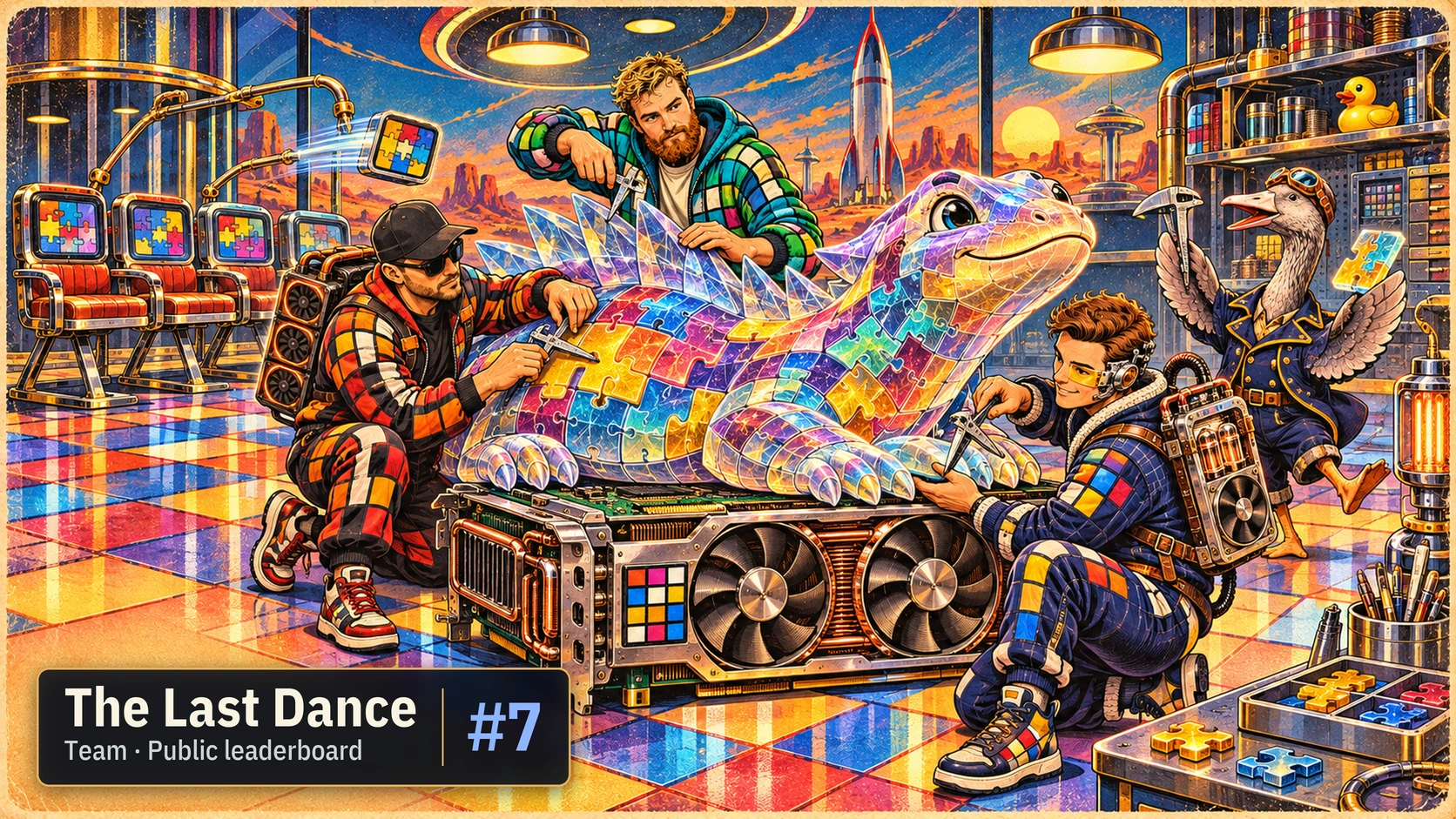
Three grid-suited dancers and a grey goose measure a glowing puzzle creature on a graphics card in a retro-futurist workshop.
The Goose imagines The Last Dance trimming a giant model while their games take turns.

A giant takes the floor

The Last Dance took a giant model to the ARC-AGI-3 floor and started cutting it down to size. Then the researchers gave its games a rota. Their verdict: the model solved most games once it knew the rules, while some still resisted. Finding those rules is the fight.

Florian Sestak, Lukas Aichberger, Mykyta Ielanskyi and Günter Klambauer signed the team’s write-up from the Institute for Machine Learning at Johannes Kepler University in Linz. The Last Dance finished seventh on the public leaderboard. The private board will have its own say.

A very large model, a very small room

The crew began with NVIDIA’s Qwen3.8-Flash-Next, a model with hundreds of specialist parts. They watched the full model play through their own game harness, tried different ways to prune it and kept the best-performing recipe. More than a third of the specialists went. The smaller model left more room for game memory on the graphics card.

The team credits roughly half its progress to fitting more model and memory on the card, and half to the harness around it. In its timeline, the largest listed jump came from memory changes.

Memory first, then manners

The dancers started from Tufa Labs’ Duck harness and kept its idea of one Python tool that lives through the game. They cut their instructions back and removed a request to use as few moves as possible. When they put that request back, the team reports, the agent took fewer moves but cleared fewer levels.

One reminder survived at the end of each game message: use code for counts and positions instead of reading the frame by eye.

Musical chairs for games

The server could run 25 games at once. Each game got an opening stretch; later, a stalled game could yield its seat to a waiting or more promising one, then return with its conversation and notes intact. The team weighted priority by the score still available and the chance of clearing the current level soon.

The model that needed a rulebook

The team wrote down the rules of each public game and gave the model a short hint for each level. Its score jumped. The researchers’ reading: playing the games was less of a problem once the model understood them; working out the rules was the bigger gap.

Even the rulebook could not fix everything. In two scrolling games, the agent lost track of the scene as the camera moved. The team tried stitching views into a map. It helped on the first scrolling level, but the overall score did not change, and the map stayed out of the final entry.

Other experiments came up short: three attempts at building game models did not clear more levels, and about a third of model-written summary requests returned nothing usable. The team continued stuck conversations with a question about what the model believed and what blocked it.

The Last Dance has put its notes on the table. Who will teach the next model to discover the rules for itself?

The Last Dance — public leaderboard solution overview · ARC-AGI-3 public leaderboard