tr87 — ARC-AGI-3 game guide
Full spoilers for this public game. Play first if you want to discover its rules yourself.
Translate a phrase into a second alphabet using a wall of paired runes as your only dictionary -- in the last two levels, the answer is already right and you repair the dictionary instead.
You translate a phrase into a second alphabet by matching each symbol to its paired rune on the wall. In the last two levels the answer is already right, and you fix the wall of rune-pairs instead of translating.
Controls
- ACTION1: Change the selected glyph to the previous glyph of its alphabet (levels 5-6: every glyph on the selected dictionary side)
- ACTION2: Change the selected glyph to the next glyph of its alphabet (levels 5-6: every glyph on the selected dictionary side)
- ACTION3: Move the bracket left along the answer row (levels 5-6: to the previous dictionary side)
- ACTION4: Move the bracket right along the answer row (levels 5-6: to the next dictionary side)
Level by level
Level 1
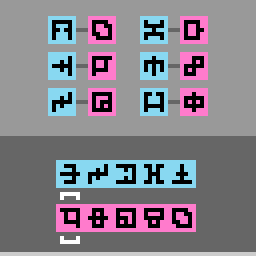
- Left and Right move the bracket along the answer row. It wraps around from one end to the other.
- Up and Down change the glyph under the bracket to the previous or next glyph of its alphabet, wrapping around after the 7th. The glyph keeps its tilt when it changes.
- Win when the answer row is the phrase translated. The phrase is read left to right; at each point the game uses the first dictionary entry (reading the wall row by row) whose left side matches, and the answer has to continue with that entry's right side. The check runs after every Up or Down, so the level ends on the press that finishes the translation.
- The top half of the screen is the dictionary. Each entry is a glyph on a colored tile, a short dark gray line, and its translation on tiles of another color. The tile color tells you the alphabet: light blue, light pink and, from level 2, yellow. Each alphabet has 7 glyphs.
- The bottom half has two rows. The top row is the phrase, which can never be changed. The row under it is your answer, marked by a white bracket above and below the selected glyph.
- A glyph's tilt means nothing. Every glyph gets a random quarter-turn when the level loads, so the same glyph can appear tilted differently in the phrase, the answer and the dictionary. Only which glyph it is counts.
- The strip along the bottom edge is the move budget: light gray is what's left, darker gray is used. Every arrow press costs one, cursor moves included. You get 128 per level on levels 1 to 5. At zero you lose, unless that last press completed the translation.
- On a win, each translated chunk of the phrase and answer changes color in turn (red, green, purple, pink, blue, orange, then white), and the dictionary entry used for that chunk gets a white outline. Then the next level loads.
- The answer row starts scrambled, and the scramble and the tilts are the same every time the level loads.
- RESET restarts the level with the same scramble and a full budget. There is no undo; you fix a wrong glyph by pressing the opposite arrow, which costs moves too.
Level 2
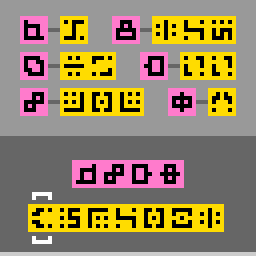
- An entry can turn one glyph into two or three, so the answer row is longer than the phrase. Level 2 translates light pink into yellow.
Level 3
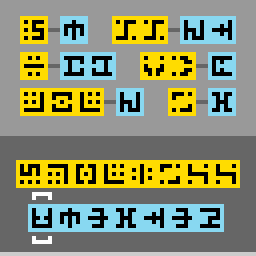
- An entry's left side can be a group of two or three glyphs, which translates as one unit. Level 3 translates yellow into light blue, and the answer row is shorter than the phrase.
Boss, 2026-09-17: The only controls are up, down, left, right and RESET, and RESET is not something you should need in this game. Even on level 3 there is no solid rule he has been able to pin down. It is a lot like SB26: the game asks you for a certain code, only with freaky-looking symbols instead of colors. The symbols also do not always have to be pointed the right way. Played it having seen it before and knowing roughly what it is about. Once you know that much it is shockingly easy -- and it would have taken him literally forever if nobody had told him, because it just would not occur to you. He is still playing it badly. It is programmer talk turned into a game, working in abstractions: the top half of the screen always shows you the key, what the game wants, and in the bottom half you cycle through the runes with the arrow keys.
Level 4
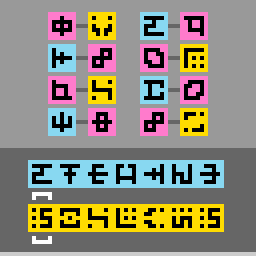
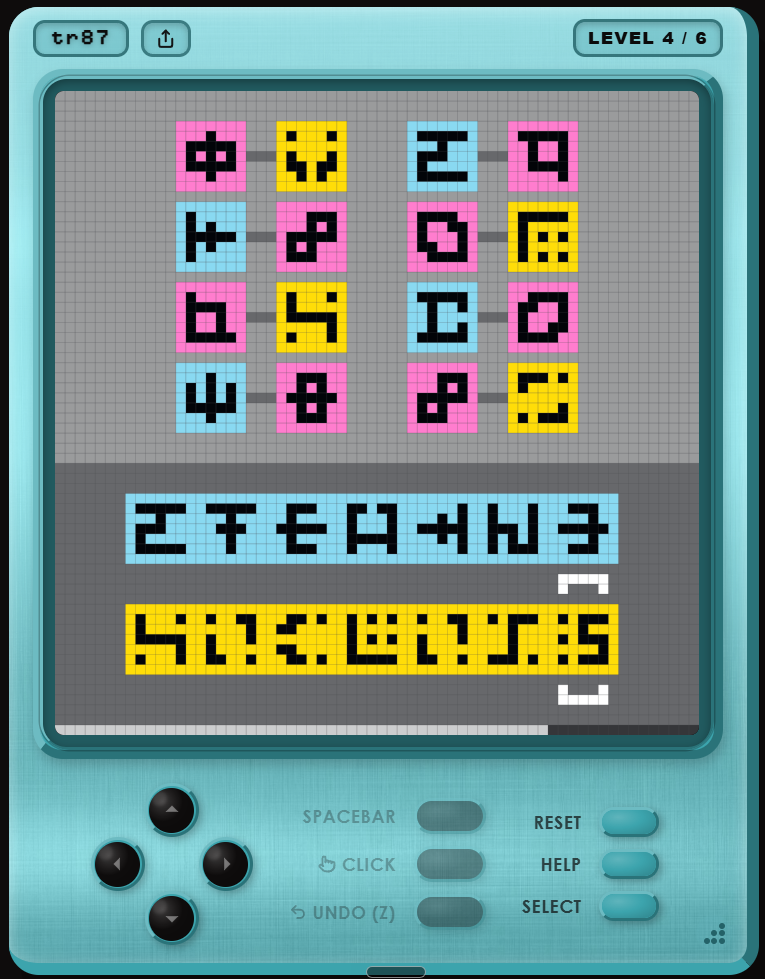
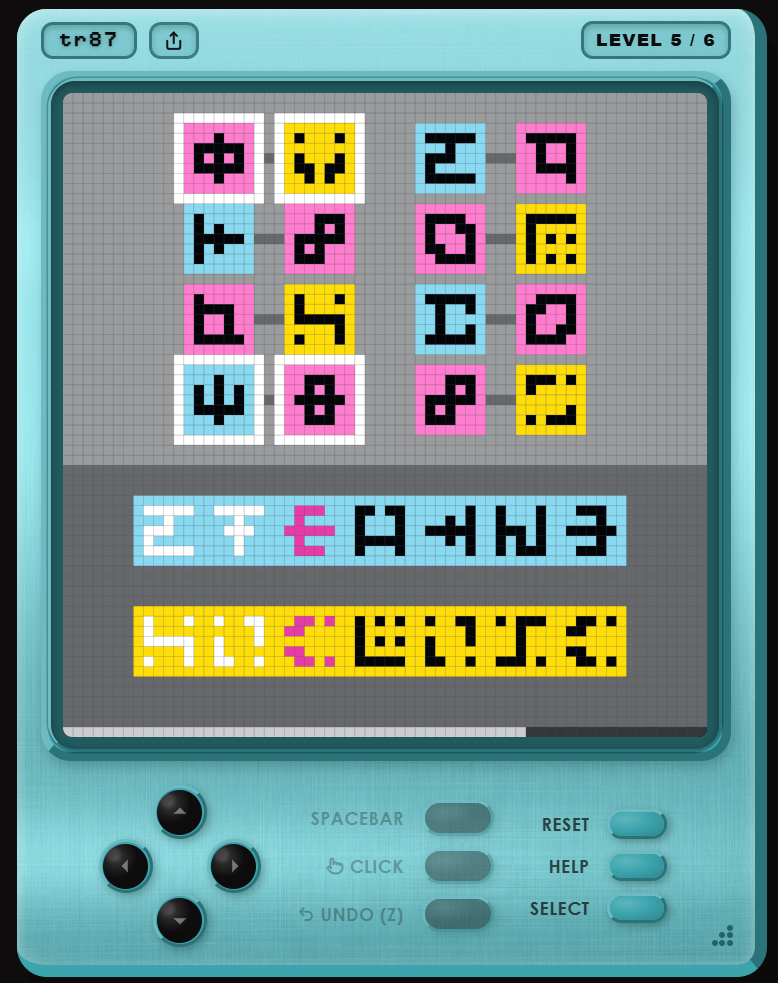
- Two-step translation. The phrase is light blue and the answer is yellow, but no entry goes straight from light blue to yellow. Look each phrase glyph up to get a light pink glyph, then find the entry that starts with that light pink glyph; its yellow right side is what goes in the answer. Light pink only appears on the wall.
Boss, 2026-09-17: In a lot of these games you have to press spacebar or some other action to confirm that the sequence you entered is the one you want. There is none. The moment the sequence is right it lights up, flashes, plays an animation and takes you to the next level. Bizarre.
Level 5
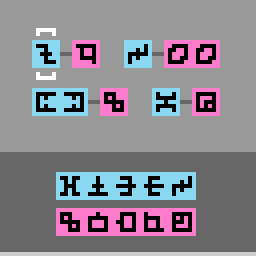
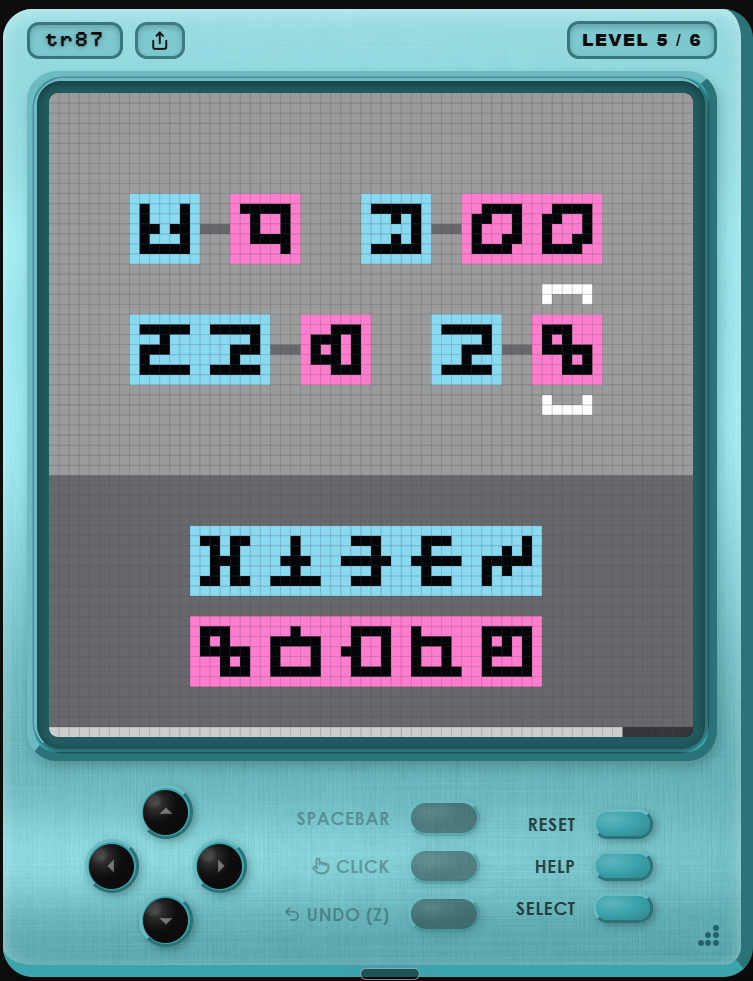
- In repair mode, Left and Right step the bracket through the dictionary instead: the first entry's left side, then its right side, then the next entry, wrapping around. The bracket stretches over the one, two or three glyphs of the selected side.
- In repair mode, Up and Down change every glyph on the selected side by one glyph together, so a side made of two identical glyphs stays two identical glyphs.
- Repair mode. The answer row is already the target and can't be changed. Each side of each dictionary entry starts shifted by its own amount, and you win by fixing the wall until it translates the phrase into the answer row.
Boss, 2026-09-17: On level 5 he is only allowed to select things up in the area that previously gave him the legend. The puzzle is inverted from here: the answer row is already right and frozen, and the dictionary itself is what you change.
Level 6
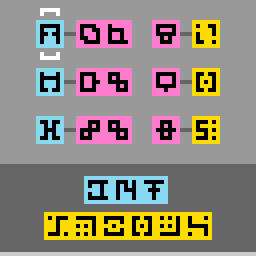
- Branching translation, still in repair mode. Each light blue phrase glyph translates into two light pink glyphs, and each of those is looked up on its own in a light pink to yellow entry, so three phrase glyphs become six yellow answer glyphs. You have to repair both kinds of entry.
- The move budget doubles to 256.
Mechanics
The top half of the screen is a dictionary: entries of glyphs on colored tiles, each linked by a short line to its translation, with the tile color marking the alphabet. The bottom half holds the phrase (never editable) and your answer row. In levels 1-4 you move a white bracket along the answer row with Left/Right and step the glyph under it through its alphabet with Up/Down, until the answer is the phrase translated entry by entry. The tilt of a glyph is random and means nothing; only which letter it is counts. Level 2 adds entries that turn one glyph into several, level 3 adds entries that turn a group of glyphs into one, and level 4 hides the direct translation: you look the phrase up into a middle alphabet that only appears on the wall, then look that up again. In levels 5-6 the answer row is fixed and correct and the dictionary is scrambled instead: Left/Right step through the sides of the dictionary entries, and Up/Down change every glyph on the selected side by one letter together, until the wall translates the phrase into the answer. Level 6 also branches: each phrase glyph becomes two middle glyphs, each looked up on its own. A move budget (128 actions in levels 1-5, 256 in level 6) ticks down on every action, including a bare cursor move; run out and you lose.
Notes and caveats
Renamed from "Tongue Runes" to "Toggle Runes" 2026-09-17 at Boss's call, playing it: you toggle the runes in a certain way, and that is what the game is about. Added 2026-09-11 when the informal-name registry was extended from the original 6 games to the full 25-game public demo set. No replay video or hints exist yet for this game -- only the level screenshots rendered from their own game source on 2026-09-12 and the two replay links ARC Prize published with the GPT-6 Astra results. Corrected 2026-09-12: the original "adversarially verified" pass still missed that levels 5-6 invert the puzzle, caught by a second, independent re-verification.
All official game guides · The Slippery Seven · Human and AI results