sk48 — ARC-AGI-3 game guide
Full spoilers for this public game. Play first if you want to discover its rules yourself.
Extend, retract and slide a skewer that pushes colored beads ahead of its tip and skewers the ones that can't move, until the beads on each skewer match the reference skewers at the bottom.
You extend, pull back and slide a skewer to push colored beads around and skewer them. Get the beads on each skewer into the same color order as the reference skewer shown at the bottom before you run out of energy.
Controls
- ACTION1: Extend/retract Up
- ACTION2: Extend/retract Down
- ACTION3: Extend/retract Left
- ACTION4: Extend/retract Right
- ACTION6: Select a skewer
- ACTION7: Undo — One of only 3 public games (with bp35, lf52) where Undo is load-bearing, not a convenience -- see notes below.
Level by level
Level 1
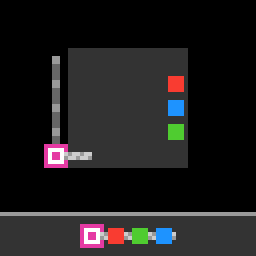
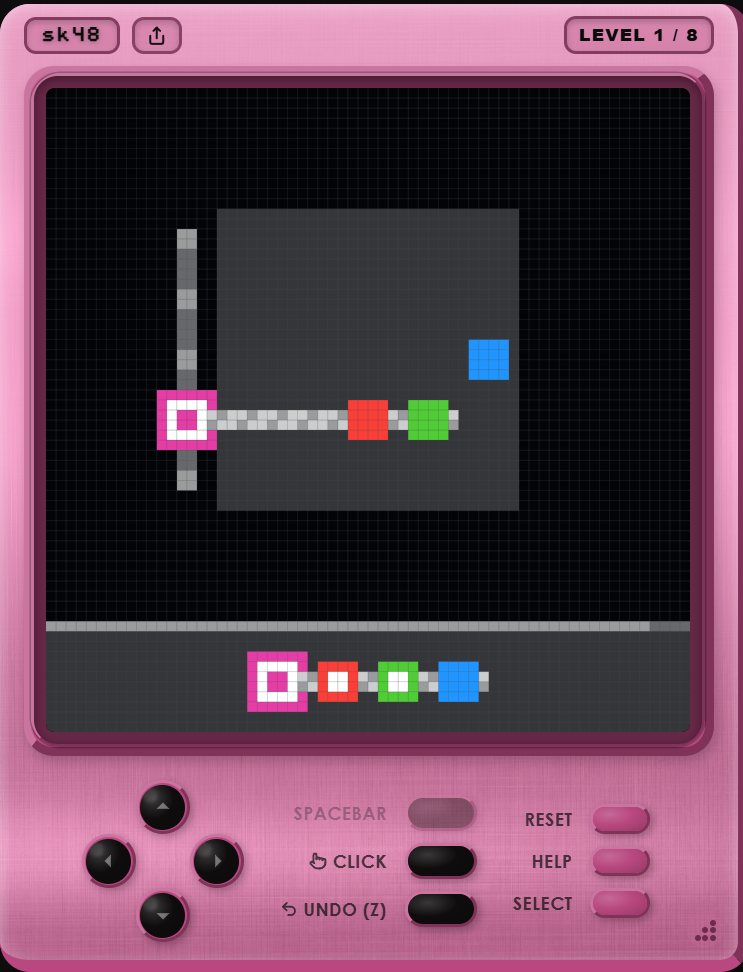
- Press the direction the selected rod points (away from its handle) to extend it one segment. Press the opposite direction to pull it back one segment. It never shrinks below the one segment under its handle.
- Press a sideways direction to slide the whole rod, handle and all, one step along the striped gray rail beside the handle. Where the rail ends, or with no rail, nothing moves.
- Every direction press costs 1 energy, even when nothing moves.
- Undo (ACTION7) puts the rods and beads back as they were before your last move that changed something, and you can keep pressing it back to the level start. It is free, but it does not give back energy.
- RESET restores the level with full energy.
- The strip below the long line at the bottom shows a reference rod with a row of colored beads for each rod that counts, matched to it by handle color. The level clears when the beads on each of those rods, read outward from its handle, have the reference's colors in the same order.
- Only the first as many beads as the reference holds are checked; extra beads further out on the rod don't matter.
- Your rod is a gray zigzag bar sticking out of a pink square handle. Beads are small colored squares. Level 1 has one rod, a rail beside its handle, and a column of red, blue and green beads to be skewered as red, green, blue.
- Extending pushes a loose bead just ahead of the tip along in front of it, and beads already on the rod ride forward with it.
- A bead that can't be pushed any further (board edge, wall, or another bead that is stuck) stays where it is and the rod slides through it. That is how a bead gets skewered.
- Pulling the rod back drags the beads on it back toward the handle. A bead right next to the handle has nowhere to go, so the rod pulls out of it and leaves it loose.
- Sliding carries every bead on the rod and pushes loose beads in its way. If a bead would be pushed off the board, the slide doesn't happen.
- The tip can't go past the edge of the board. An extension that would do that does nothing, and still costs 1.
- When energy hits 0 the game is over. There are no lives. A move that clears the level with your last point still counts.
- Each level gives 196 energy, and only direction presses spend it. Clicks and undo are free.
- The long line above the bottom strip is the energy bar: gray for energy left, dark gray for energy spent. It refills at the start of each level.
- A white dot appears on a reference bead whenever the bead in the same position on the matching rod has the same color, so you can see which positions are already right.
- When a bead gets newly skewered, an outline in the bead's color flashes around it for a moment.
- The selected rod's handle has a white inside and its rod is drawn a lighter gray. Its reference in the bottom strip lights up the same way.
- On a clear, all the beads on the rods flash white a few times before the next level loads.
Level 2
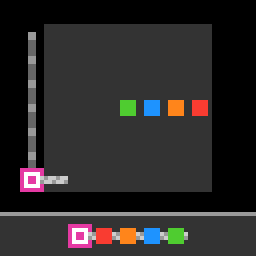
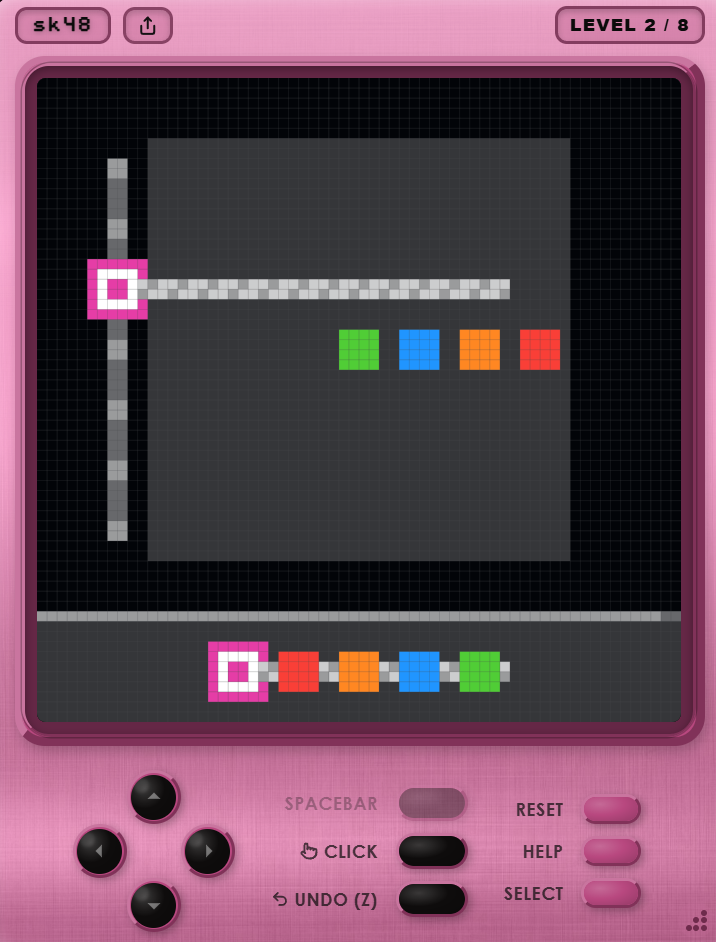
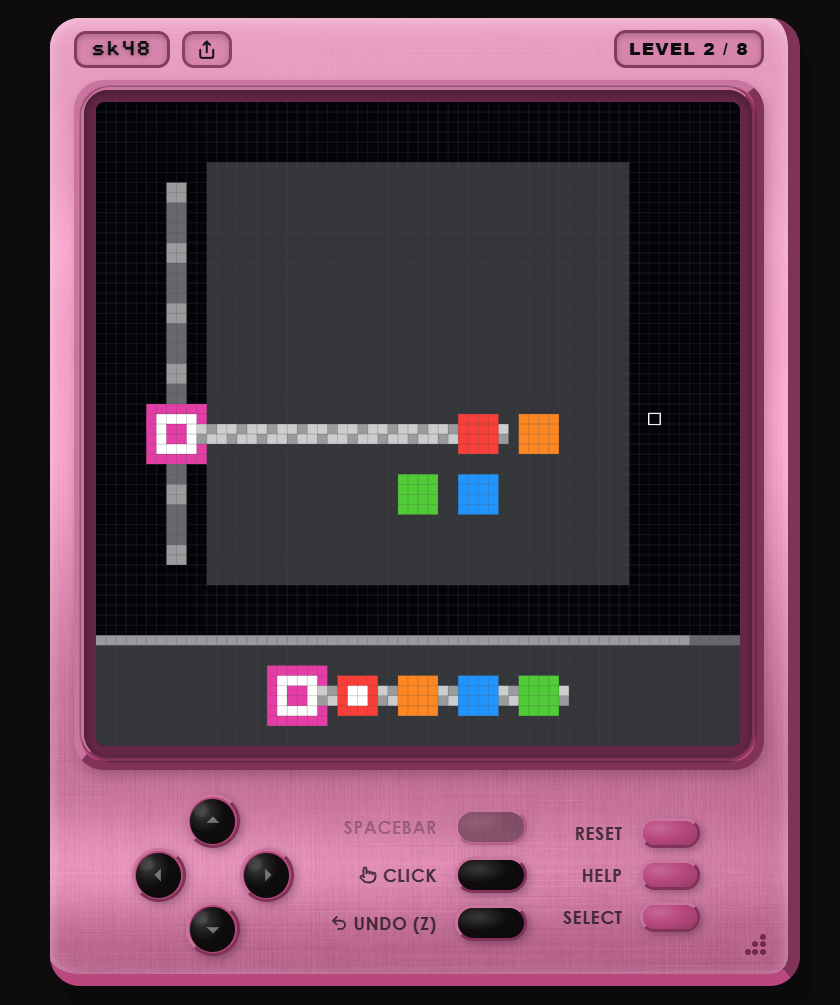
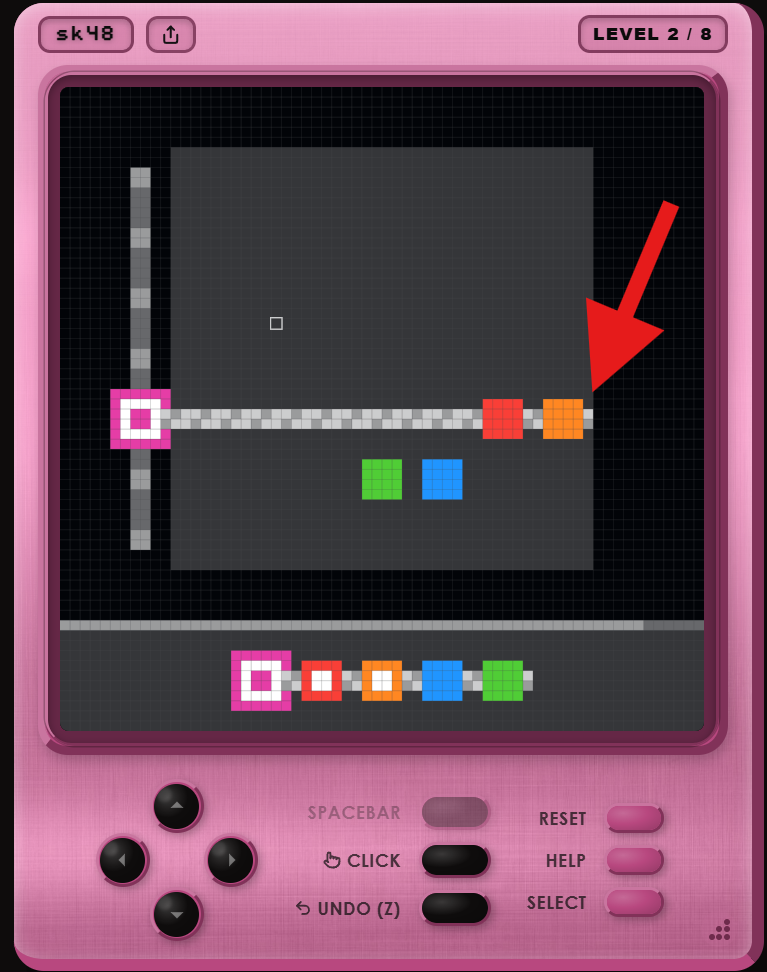
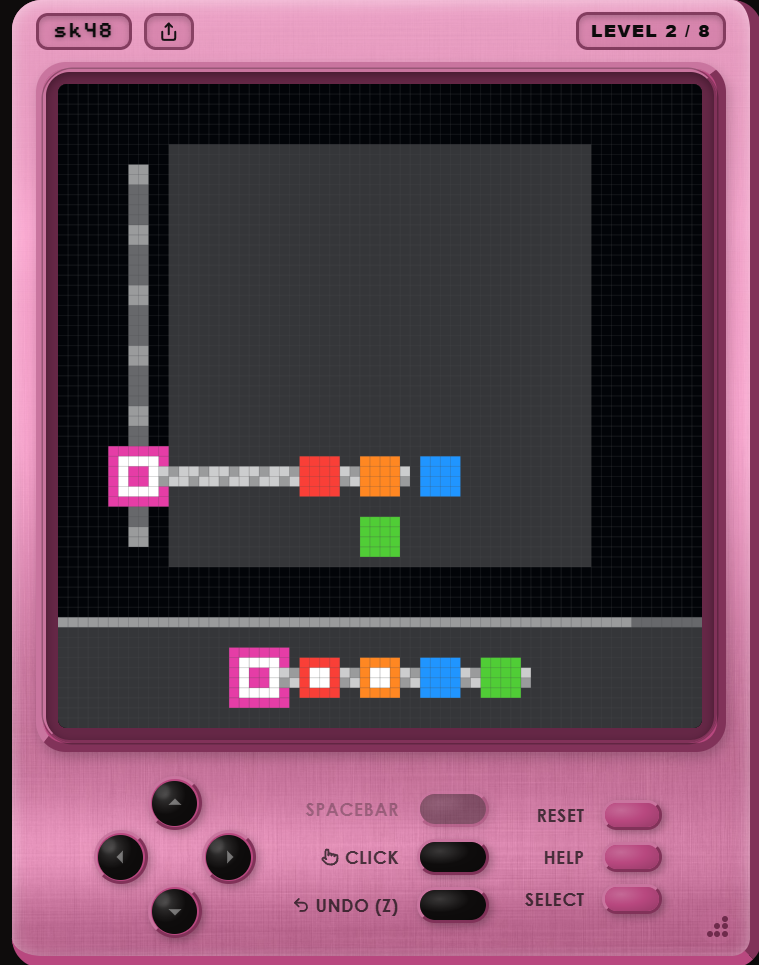
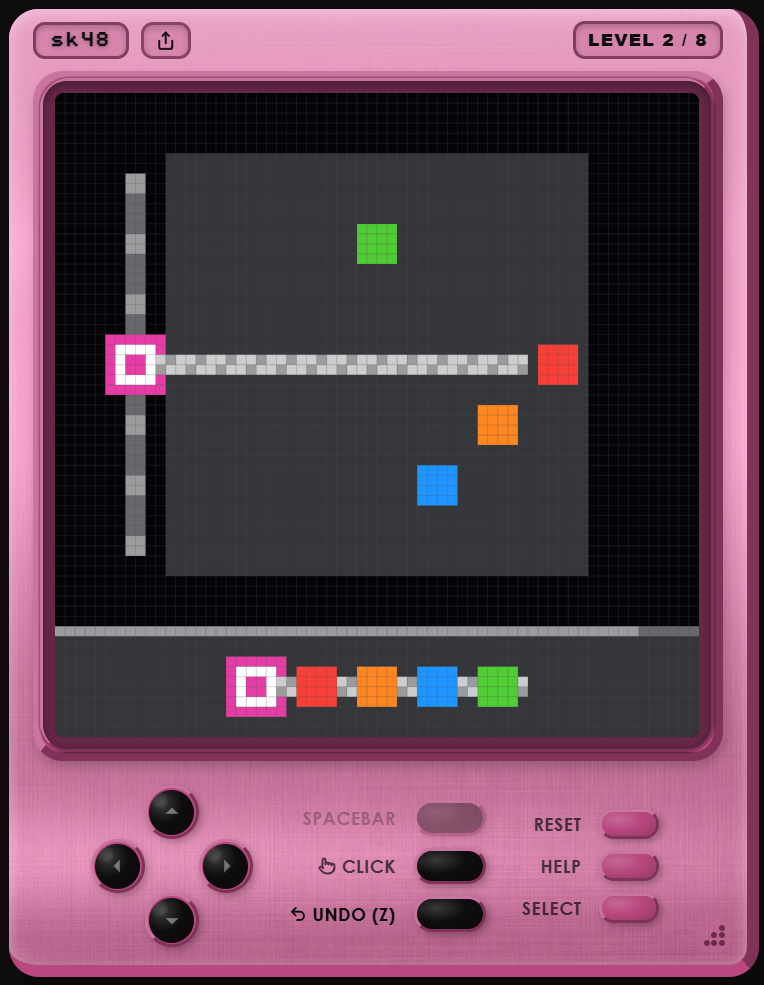
Boss, 2026-09-11: The skewers at the bottom of the screen show the order the colored boxes are wanted in. Extended the long rod to spear the boxes. It is an extendable meat skewer and the boxes are pieces of meat going onto it in a set order. It is physics: you can't just get up close to a box, you have to push it against the wall and spear it. Once speared it comes along with you on the rod, and it is solid, so you can use it to push the other boxes down.
Level 3
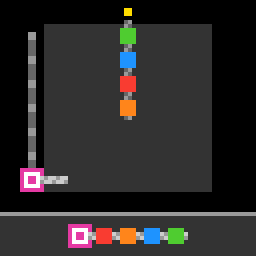
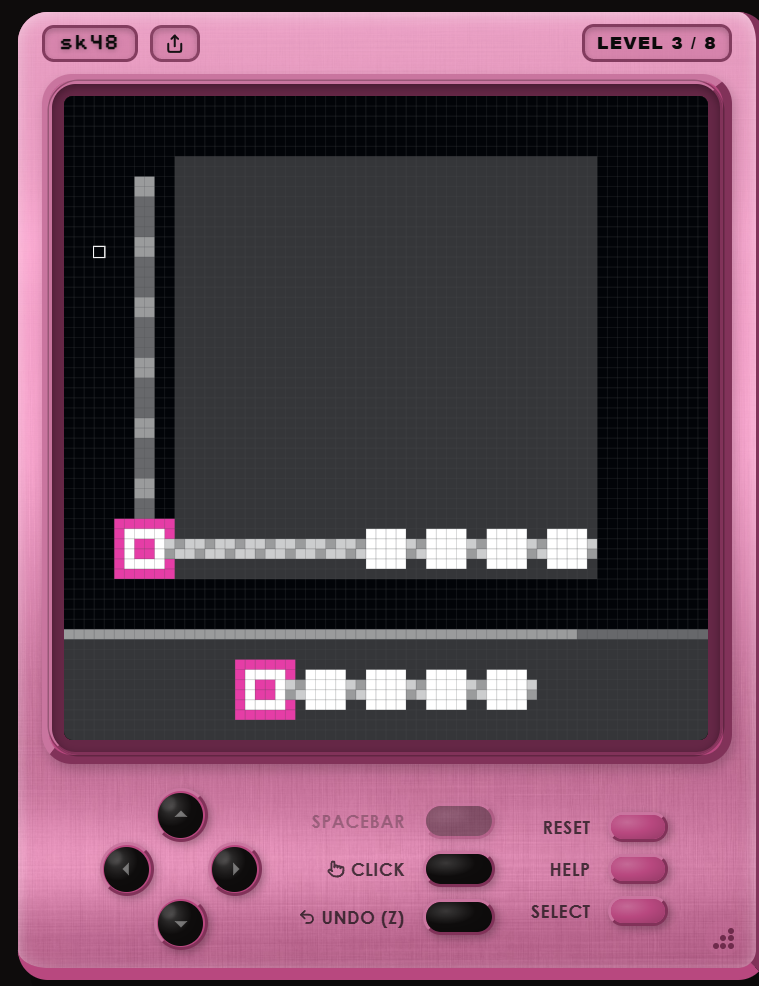
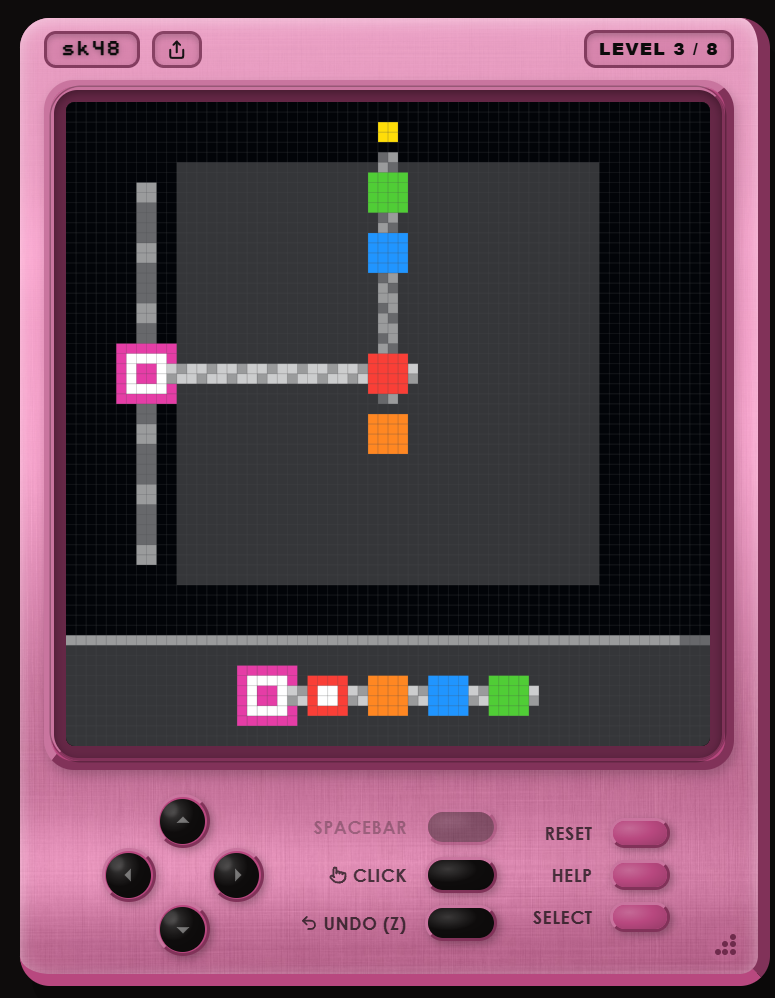
- A fixed rod appears: a vertical rod with a black handle and a yellow center, which you can't select or move. Your rod passes straight through it. A bead on it can slide up and down along it (your rod can carry it that way), but nothing can push it sideways off the rod.
Level 4
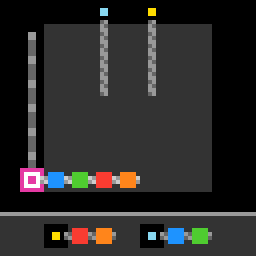
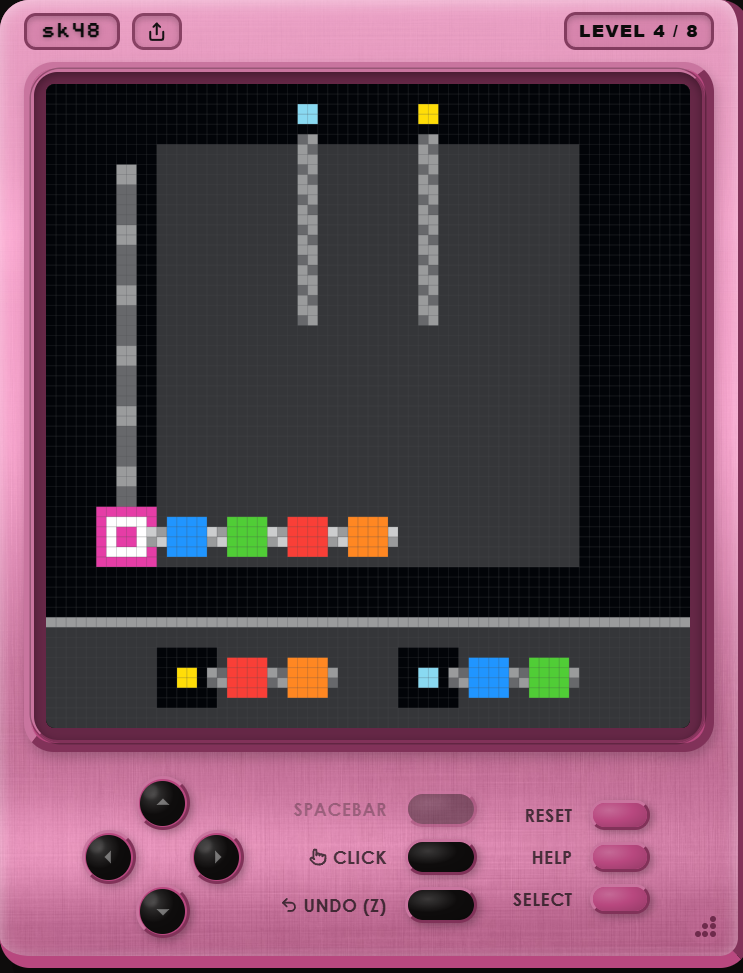
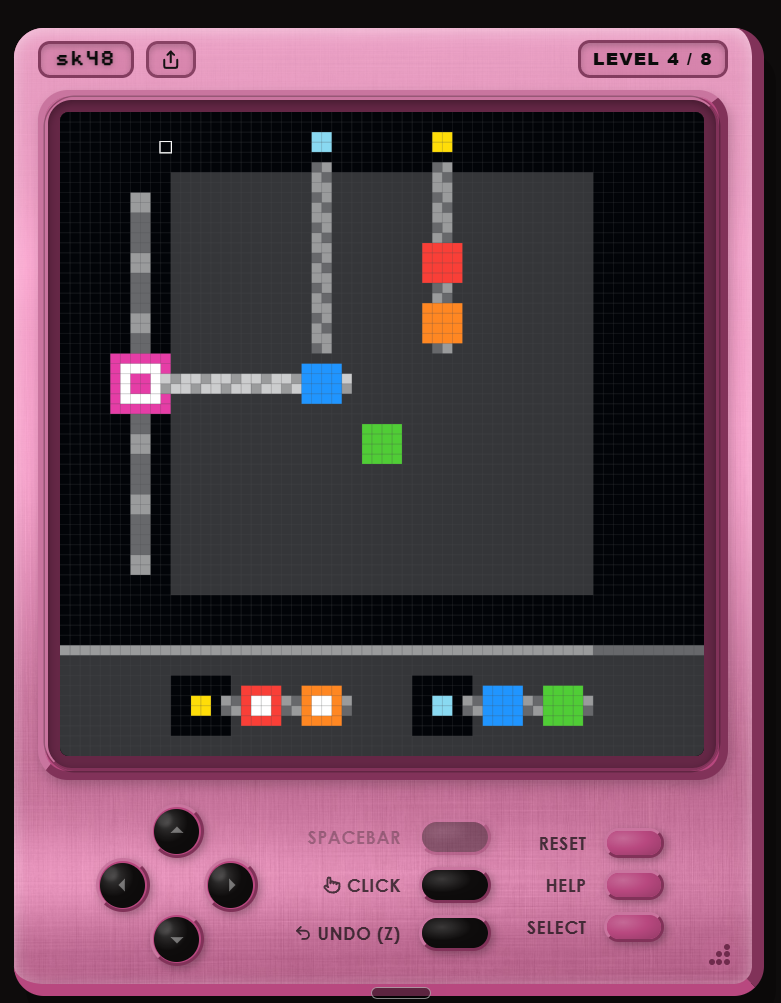
- The rods you must fill can be ones you don't control. On level 4 the two references belong to the two fixed rods at the top (light blue and yellow centers), and your pink rod has no reference at all: it is only a tool for moving beads onto them.
Boss, 2026-09-11: Level 4 starts with pieces already on the skewers. The meat-skewer picture still explains it. The AI runs he read had called the rod a pen or a snake's tongue, and none of their guesses would handle this level.
Level 5
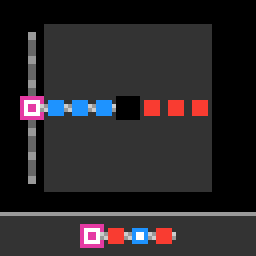
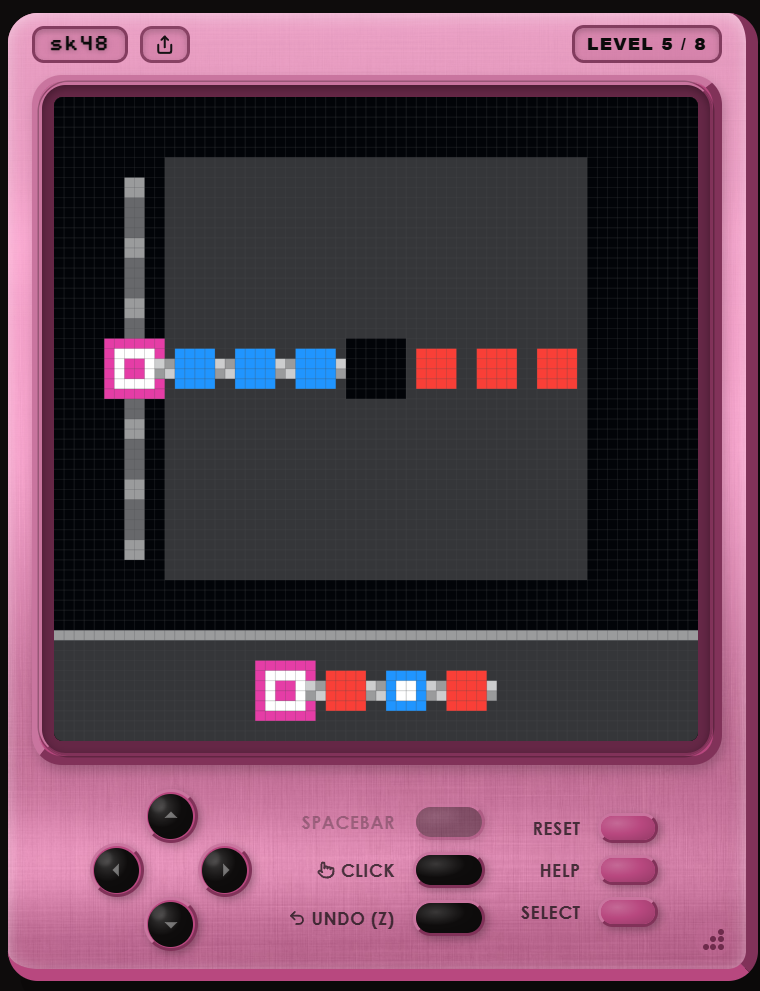
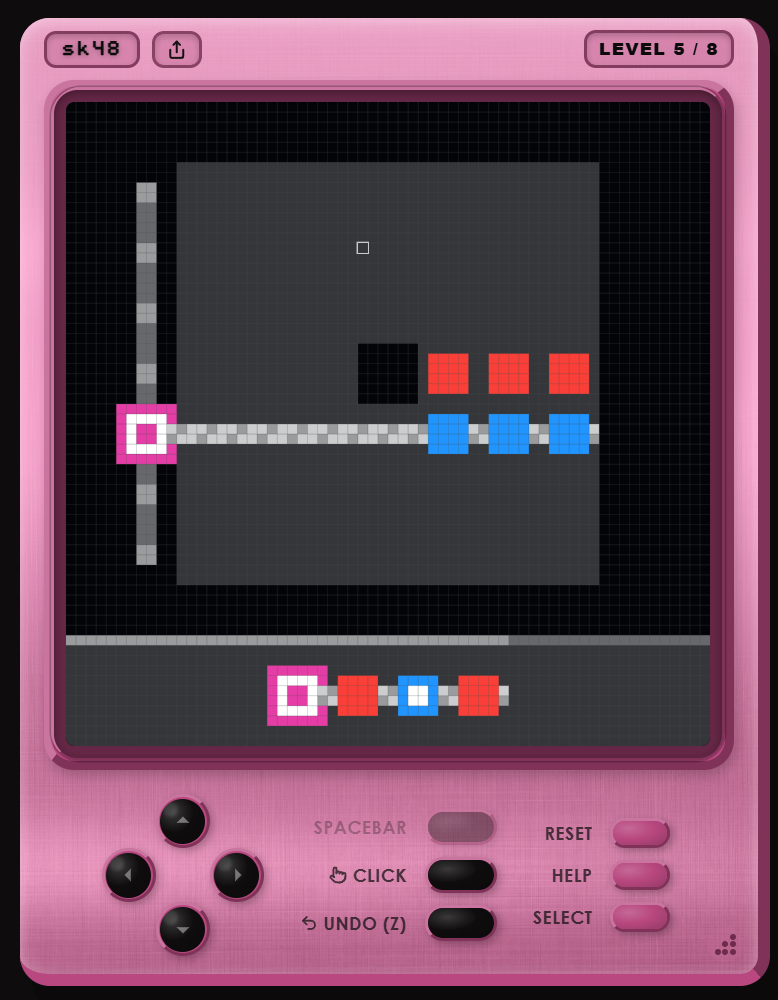
- Solid black wall squares appear on levels 5 and 6. The tip can't extend into one and beads can't be pushed into one.
Boss, 2026-09-11: A black box blocks the skewer, with red boxes behind it. Clicked on everything on the screen. Clicking changed nothing. He worked the level out by experimenting.
Level 6
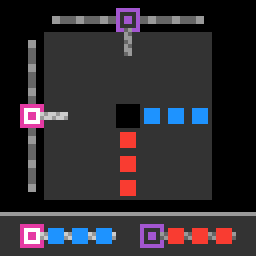
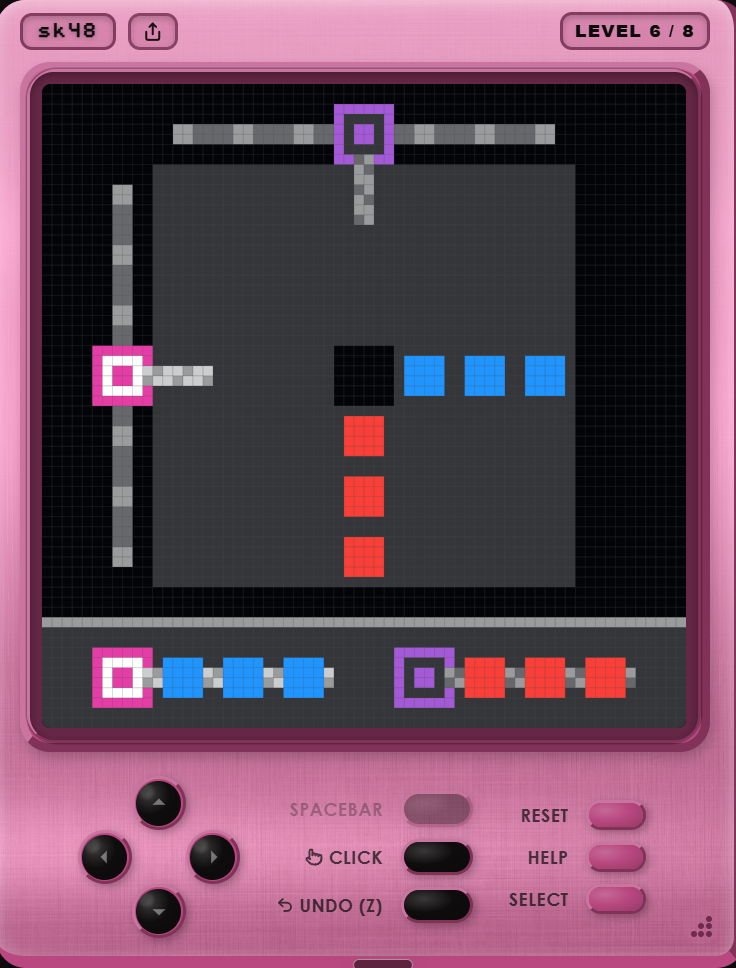
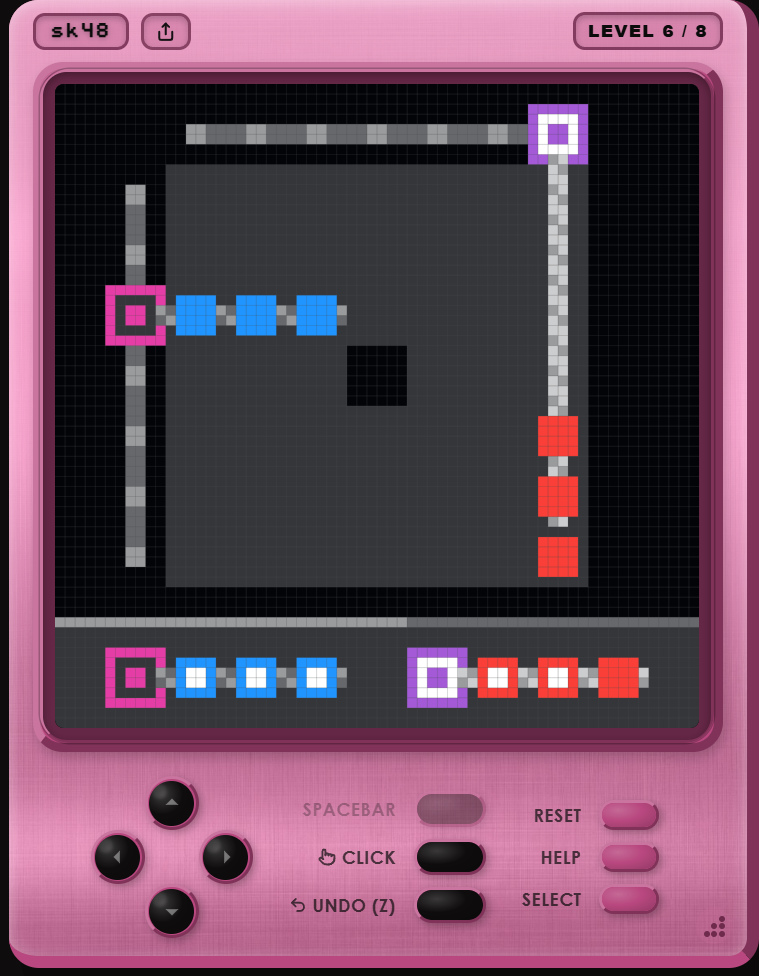
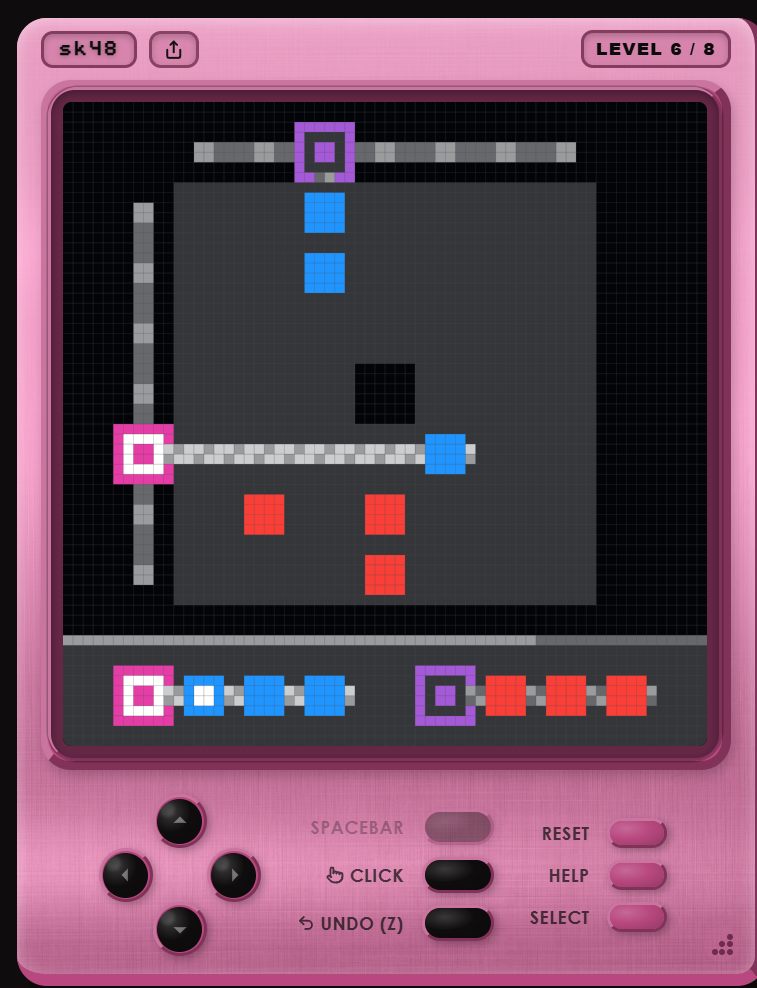
- Two rods you control, pink and purple. Click a rod's handle, or its reference in the bottom strip, to switch to it. Switching is free, and clicking anything else does nothing.
- The purple rod hangs down from the top and slides left and right along a rail across the top. The two rods pass straight through each other.
Boss, 2026-09-11: Level 6, right before the win. Each skewer is matched to its own reference at the bottom. They are not always pairs of skewers, and a skewer does not have to match a partner.
Boss, 2026-09-21: Two skewers to work with, pink and purple, and each one wants different colors. Clicked to switch which skewer he was using. Clicking does nothing in this game until level 6 of 8. From there it is how you switch skewers.
Level 7
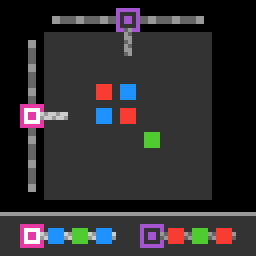
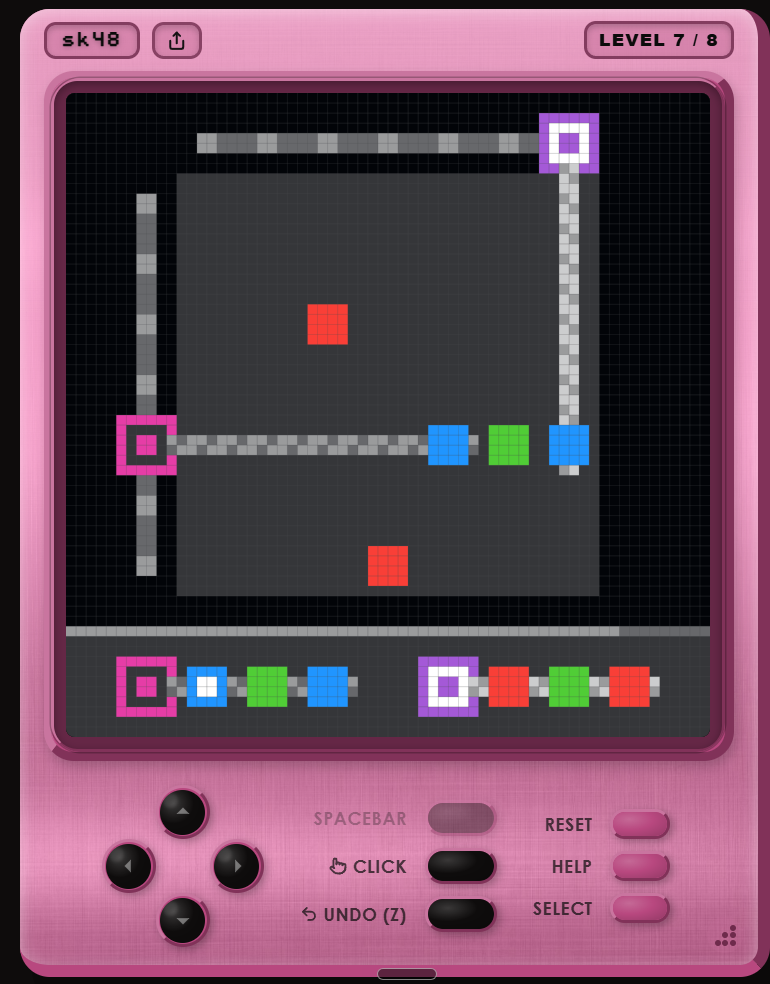
- The two rods have to share a bead. The board has one green bead, two blue and two red, and both references want green in the middle: pink wants blue, green, blue and purple wants red, green, red. The one green has to end up where the two rods cross, counting for both.
Boss, 2026-09-21: Pink and purple skewers, and both of them need green. Level 7 is insane: the two skewers have to work together because they share the green peas.
Level 8
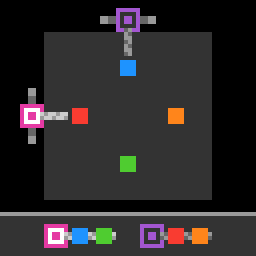
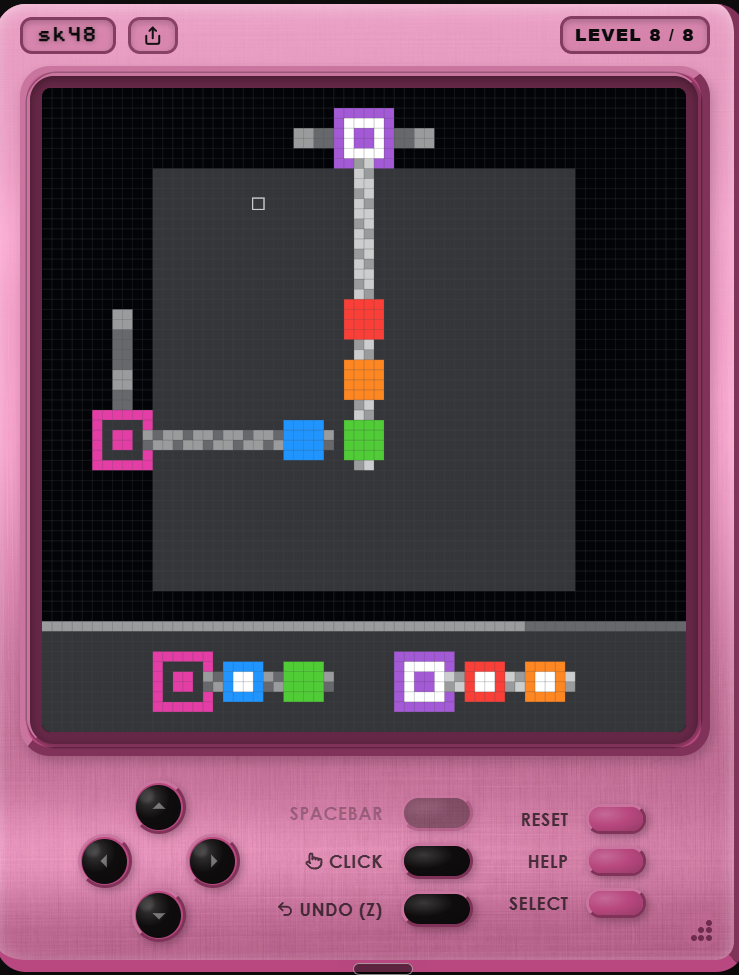
- Pink's rail shrinks to two segments, so the pink rod can barely slide up or down and can't get to the lower half of the board. The green bead starts down there, straight below the purple rod, so only purple can bring it up. Pink wants blue then green; purple wants red then orange.
Boss, 2026-09-21: The purple skewer can reach the bottom of the board; the pink one on the left can't. The fiendish part: you absolutely have to work with the other skewer to win level 8.
Mechanics
Each rod sticks out of a square handle. Pressing the rod's own direction extends it one segment, pressing the opposite way pulls it back one segment, and pressing sideways slides the whole rod one step along the striped rail beside its handle (no rail, no slide). Extending doesn't pass through loose beads -- it pushes each one ahead of the tip -- but a bead that can't be pushed any further (board edge, wall, or another stuck bead) stays put and the rod slides through it, skewering it. Beads already on the rod ride along when it extends, get dragged back when it retracts, and get carried when it slides; a slide that would push a bead off the board doesn't happen, and the tip can't go past the board edge or into a wall. The strip at the bottom holds a reference rod for each rod that counts: the level clears when the beads on each matching rod, read outward from its handle, have the reference's colors in the same order, and a white dot marks each position that already matches. From level 3 there are fixed rods you can't move, and on level 4 the references belong to two fixed rods while your own rod is only a tool. Solid black walls appear on levels 5 and 6, and from level 6 you switch between two rods by clicking a handle. Every direction press costs 1 of the level's 196 energy; clicks and undo are free, undo restores rods and beads but not energy, and running out of energy ends the game.
Notes and caveats
Added 2026-09-11 when the informal-name registry was extended from the original 6 games to the full 25-game public demo set. No replay video or hints exist yet for this game -- only the level screenshots rendered from their own game source on 2026-09-12 and the two replay links ARC Prize published with the GPT-6 Astra results. Corrected 2026-09-12: adversarial re-verification confirmed the skewer pushes beads rather than passing through them, and added the level-5+ solid walls; the win-condition specifics are still an open gap. ACTION7 (Undo) cross-game note (2026-09-14): Boss identifies sk48 as one of only three public games (with bp35 and lf52) where Undo is load-bearing rather than a convenience -- see bp35.ts for the full breakdown of which games expose ACTION7 at all. Reasoning for why it matters here specifically: this is a push-block mechanic (the skewer shoves beads ahead of its tip instead of passing through them), and push-block puzzles are the classic case where moves are one-directional -- retracting or sliding the skewer back does not pull a pushed bead back with it, so a bad extension can permanently scramble the bead arrangement with no way to recover it by further play. That is presumably why the source implementation makes Undo explicitly restore bead positions, not just skewer position (per mechanicsExplanation) -- ordinary movement cannot undo a push, only the dedicated Undo can. Bounded by a step budget same as bp35/lf52, so Undo also saves you from re-spending moves re-deriving a bead layout a Reset would have thrown away.
All official game guides · The Slippery Seven · Human and AI results