lp85 — ARC-AGI-3 game guide
Full spoilers for this public game. Play first if you want to discover its rules yourself.
Click red and green buttons to turn loops of colored squares back or forward until every yellow square (and, on levels 3-4, the orange one) sits inside a target of its color, marked by four corner dots.
Each button turns a loop of squares one step forward (green) or back (red). Turn the loops until every yellow square sits inside a yellow target, marked by four corner dots, and on levels 3-4 the orange square sits in the orange one.
Controls
- ACTION6: Click Red/Green button to shift blocks
Level by level
Level 1
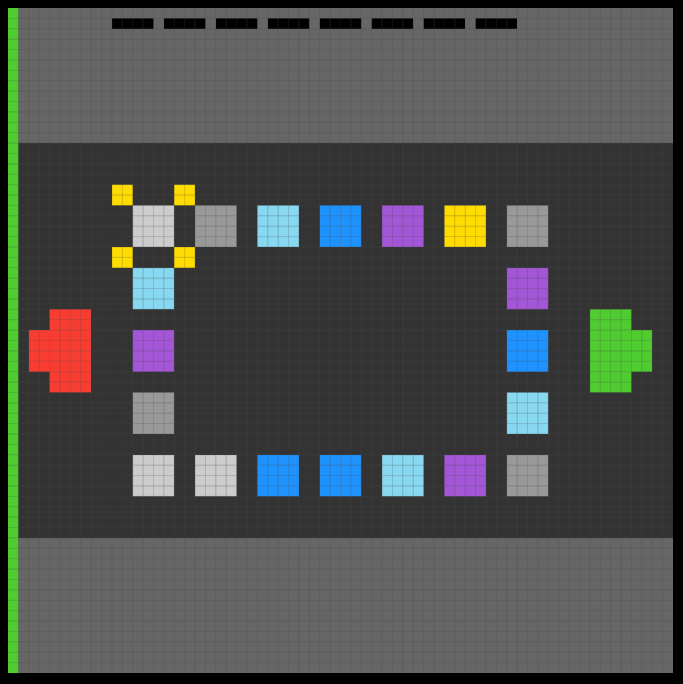
- Clicking is the only control. The buttons are small arrowheads: green ones point right and red ones point left.
- Each button belongs to one loop of slots. Click a green button and every square on its loop moves one slot forward; click a red one and they all move one slot back. The loop wraps, so going forward from the last slot lands on the first and going back from the first lands on the last.
- Clicking anywhere that isn't a button does nothing and costs nothing.
- There is no undo. RESET restarts the level with every square back in place and a full step bar.
- A target is four small yellow corner dots framing one slot. The level is cleared the moment every yellow target has a yellow square sitting in it. Any yellow square fills any yellow target.
- A loop is a chain of small colored squares (blue, light blue, light gray, gray and purple) with the yellow square among them, all the same size. The whole chain moves together. The other colors don't matter for winning, they only help you see the loop turn.
- Targets and buttons never move. Only squares sitting in a loop slot get carried along.
- There are no enemies, hazards or lives. Running out of steps is the only way to lose.
- Every button click spends one step. The levels allow 13, 60, 80, 150, 80, 80, 80 and 80 clicks. If a click uses up the last step without clearing the level, the game is over. The win check runs first, so clearing the level on your last step still counts.
- The column along the left edge of the screen is the step bar. It starts all green and turns black from the top down as you spend steps. It refills at the start of each level.
- The row of eight short dashes across the top tracks progress: one dash turns green for each level you have cleared.
- There is no animation. Squares jump straight to their new slots in a single frame.
Level 2
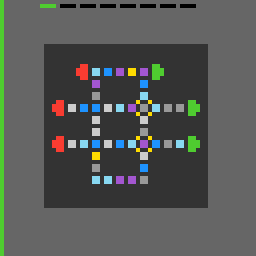
- Two yellow squares and two yellow targets. Levels 2, 5 and 7 have two, levels 6 and 8 have three.
- Several loops, each with its own red and green button. Loops cross each other, and a slot where two loops cross belongs to both, so a square sitting there can be carried off by either one. That is how a yellow square gets from one loop to another.
Level 3
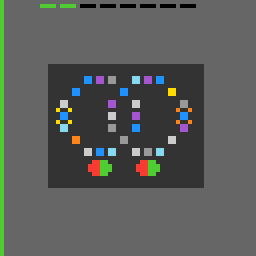
- Levels 3 and 4 have one yellow pair and one orange pair: an orange square and an orange target (four orange corner dots). The orange square has to end up in the orange target too, and a yellow square doesn't fill it.
Level 4
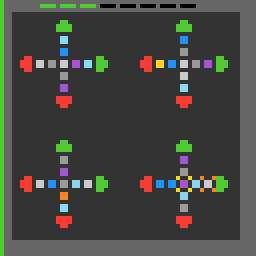
- Each button appears four times, spread around the board. All copies of a button do exactly the same thing.
Level 5
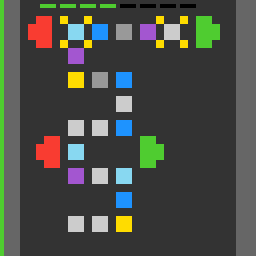
- A short loop can sit on top of part of a longer one. On level 5 a straight row of five slots belongs to both: its own buttons cycle just those five squares, with the square at the end of the row jumping back to the start.
Level 6
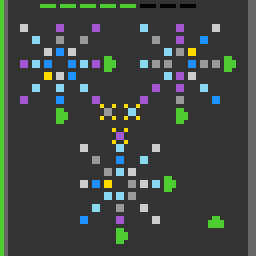
- Level 6 has only green buttons, so every loop turns one way. Several loops share each button spot, so one click turns three or eight loops at once. One spot drives three loops that have only two slots each, so that click just swaps the squares in each pair.
Level 7
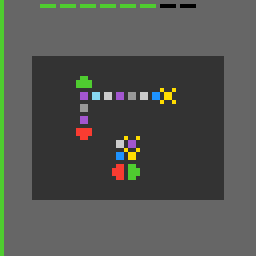
- On level 7 the red and green buttons in the middle each drive two loops at once: a straight row whose end square wraps back to the start, and a small four-slot square. A separate pair of buttons drives a three-slot loop that shares one slot with the row, so you can park a square off the row while the other two loops turn.
Level 8
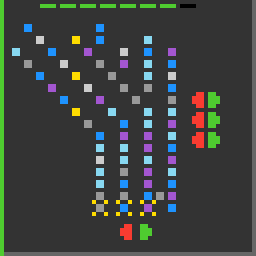
- On level 8 one red and one green button each drive three loops at once, and three more loops have their own buttons. Some colored squares are not on any loop and never move.
Mechanics
Each target is four small corner dots framing one slot, and it is filled when a square of its color sits in that slot: every yellow target needs a yellow square, and on levels 3 and 4 the orange target also needs the orange square. The number of targets ranges from one to three depending on the level, never a fixed four. You control the sequence by pushing red and green buttons. Each button belongs to a loop of slots, and a click steps every square on that loop forward (green) or backward (red) by one position, with the last slot wrapping to the first; there is no swap, push, or pull hidden in later levels. From level 2 loops cross, so a square on a shared slot can be handed from one loop to the other, and on levels 6-8 some buttons are stacked so one click turns two, three or eight loops at once. Clicks that miss the buttons do nothing and cost nothing, but every button click spends one of the level's steps (13, 60, 80, 150, 80, 80, 80 and 80 for levels 1-8), and using the last one without finishing ends the game. LP85 is a one-action game: it declares available_actions = [6] and nothing else, on every frame of a full eight-level recording. ACTION6 is a click carrying x/y coordinates, and the action space exposes no undo -- so RESET, which restarts the current level, is the only recovery primitive the game offers.
Notes and caveats
Corrected 2026-09-12 after a direct, adversarially-verified source read: levels 3-4 add a second, orange block/target pair the write-up never mentioned; the "swap/push/pull button" claim described a mechanic that doesn't exist in the code; and the mover/target sprite roles were reversed.
All official game guides · The Slippery Seven · Human and AI results